


Insights
FRS 102 Changes Are Now Effective: What UK Businesses and Finance Teams Need to Revisit in 2026
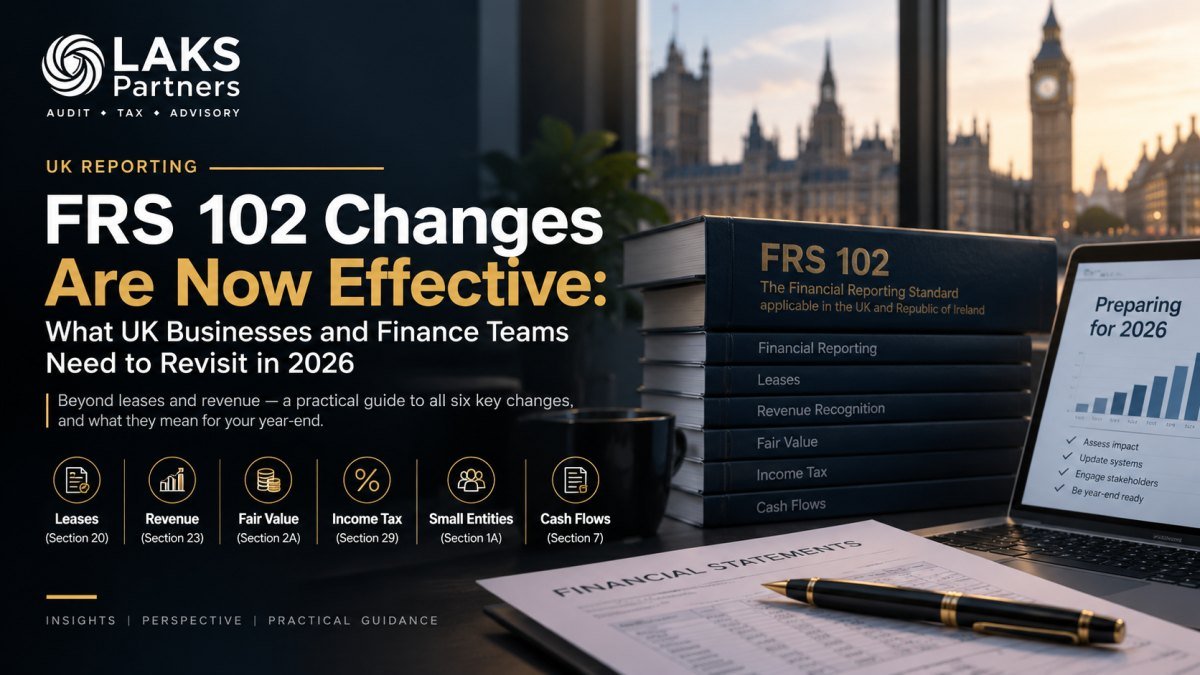
The FRC issued the amendments arising from the second periodic review of FRS 102 in March 2024. They apply to accounting periods beginning on or after 1 January 2026, with early application permitted only where all the amendments are adopted together.
Almost every summary published since has been about leases, usually with revenue attached. Both deserve the attention. But the periodic review touched six areas, and in our experience it is the other four that create the awkward conversations at year end — not because they are conceptually hard, but because nobody planned for them.
| Section | Change | Effective |
|---|---|---|
| 20 — Leases | On-balance-sheet model for lessees; operating and finance distinction removed | 1 Jan 2026 |
| 23 — Revenue | Single five-step model, aligned to IFRS 15 | 1 Jan 2026 |
| 2A — Fair value | New section, aligned to IFRS 13; definition of fair value amended | 1 Jan 2026 |
| 29 — Income tax | Guidance on uncertain tax treatments introduced | 1 Jan 2026 |
| 1A — Small entities | Disclosure changes covering leases, tax, going concern and related parties | 1 Jan 2026 |
| 7 — Cash flows | Supplier finance arrangement disclosures | 1 Jan 2025 |
Leases: the change everyone knows, and the transition most people have wrong
Section 20 removes the lessee distinction between operating and finance leases. A lessee recognises a right-of-use asset and a lease liability, with retained exemptions for short-term leases and leases of low-value assets. Lessor accounting is substantially unchanged and keeps the operating and finance classification.
Two features make this less onerous than the IFRS 16 experience it resembles.
The first is the discount rate. Where the rate implicit in the lease is not determinable, FRS 102 permits an obtainable borrowing rate rather than requiring the incremental borrowing rate that IFRS 16 demands. In practice that means a rate the entity could actually obtain on comparable borrowing, which is a defensible number a finance director can source, rather than a theoretical construct that has to be built and then justified.
The second is the transition. This is where we see the most confusion, including in published commentary.
Comparatives are not restated. Transition is modified retrospective, with a cumulative catch-up adjustment to opening retained earnings at the date of initial application.
That is a materially smaller exercise than a full retrospective restatement, and it changes how the year end should be planned. What it does not remove is the need for a complete lease population at the date of initial application — which remains the real work, and the part that cannot be compressed into the final weeks.
Transitional expedients worth knowing before you start
- An entity whose group reports under IFRS may carry forward the IFRS 16 carrying amounts of lease liabilities and right-of-use assets at the date of initial application. For UK subsidiaries of IFRS groups this removes most of the exercise.
- A single discount rate may be applied to a portfolio of leases with reasonably similar characteristics.
- Hindsight may be used in assessing lease term, which matters where break clauses and extension options were never formally evaluated.
- Leases ending within twelve months of the date of initial application may be treated in the same way as short-term leases.
The first and last of these are frequently missed. Together they can remove a substantial part of a lease population from the calculation entirely, and the assessment takes an afternoon.
Who is actually in scope
Scope does not follow size in the way most people assume, and this is the single most common error we encounter.
Three regimes, three outcomes
The lease change tracks the reporting framework, not the size of the entity.
The practical consequence is worth stating plainly. A small company preparing accounts under Section 1A brings its leases onto the balance sheet from 2026. A micro-entity under FRS 105 does not. Given that the size thresholds were uprated by roughly half in April 2025, the population sitting near that boundary is larger than it was, and for some entities the framework election is now a live question rather than a formality.
Revenue: the five-step model below the listed world
Section 23 adopts the five-step model familiar from IFRS 15: identify the contract, identify the performance obligations, determine the transaction price, allocate it, and recognise revenue as each obligation is satisfied.
For a straightforward trading business this rarely changes the number. It bites in three places that recur in owner-managed businesses: contracts containing more than one distinct performance obligation, arrangements where the entity may be acting as agent rather than principal, and long contracts subject to variation where the transaction price moves after inception. None of these are new questions, but the framework for answering them now is.
The four that get skipped
Section 2A — fair value measurement
A new section, drawn from IFRS 13, covering the market in which a measurement is assumed to take place, valuation techniques, inputs and the reliability of the resulting measurement. The definition of fair value has been amended to the exit-price formulation: the price that would be received to sell an asset, or paid to transfer a liability, in an orderly transaction between market participants at the measurement date.
For most FRS 102 reporters this is a documentation change rather than a numbers change, but it is a documentation change on investment property and financial instruments — two areas where the file is often thin already.
Section 29 — uncertain tax treatments
Section 29 now addresses uncertain tax treatments explicitly. An entity assumes that a tax authority will examine amounts it has a right to examine, and will do so with full knowledge of all related information. That assumption removes the argument that a position is unlikely to be looked at, and shifts the assessment onto the technical merits alone.
Where an entity carries positions that have been taken on the basis that detection risk is low, this is the amendment that changes the conversation.
Section 1A — small entity disclosures
Disclosure requirements for small entities have been updated for leases, tax, going concern and related party transactions. The recognition and measurement changes reach Section 1A entities in full; what is reduced is what appears in the accounts, not what has to be calculated to prepare them.
Section 7 — supplier finance arrangements
The only change on this list already in force. Disclosures about supplier finance arrangements applied to periods beginning on or after 1 January 2025. Where reverse factoring or similar arrangements exist, the disclosure is required now, not from 2026.
What this means for a December year end
For an entity with a 31 December 2026 year end, the first period under the amended standard is the one currently running. The date of initial application is 1 January 2026, and the transition adjustment is measured at that date — which means the lease population has to be established as it stood at the start of a year that is already half gone.
That is the practical pressure point. Not the arithmetic, which is mechanical once the inputs exist, but the assembly of a complete lease register from contracts that were never catalogued because, under the old Section 20, an operating lease needed only a commitment note.
Entities that have not begun that exercise are not yet late in a technical sense. They are late in a practical one.
LAKS Partners works to UK GAAP alongside UAE reporting requirements. Our team handles FRS 102 transition work — lease population reviews, transition adjustments and Section 1A disclosure — directly, as part of the engagements we support.
Talk to a partner
LAKS Partners supports UK practices and their clients on FRS 102 transition, lease register construction and measurement, Section 1A and FRS 105 framework decisions, revenue recognition under the five-step model, and year-end reporting.
Talk to a Partner
Abrar Shabbir is a dual-qualified Chartered Accountant with more than 10 years of experience in international tax advisory and finance leadership. He has advised clients across the UAE, UK and USA, and specialises in corporate tax implementation, VAT and GST compliance, cross-border structuring, tax-efficient planning, audit defence support and outsourced CFO advisory across the technology, real estate and trading sectors.
This article reflects the position as at July 2026 and is provided for general information. It is not a substitute for reading the standard or for advice on a specific engagement.